
4.8 KiB
@defgroup boards_esp32_esp-ethernet-kit-v1_1 ESP32-Ethernet-Kit V1.1 Board @ingroup boards_esp32_esp-ethernet-kit @brief Support for for Espressif ESP32-Ethernet-Kit v1.1 @author Gunar Schorcht gunar@schorcht.net @author Erik Ekman eekman@google.com
\section esp32_esp-ethernet-kit-v1_1 Espressif ESP32-Ethernet-Kit V1.1
Table of Contents
Overview
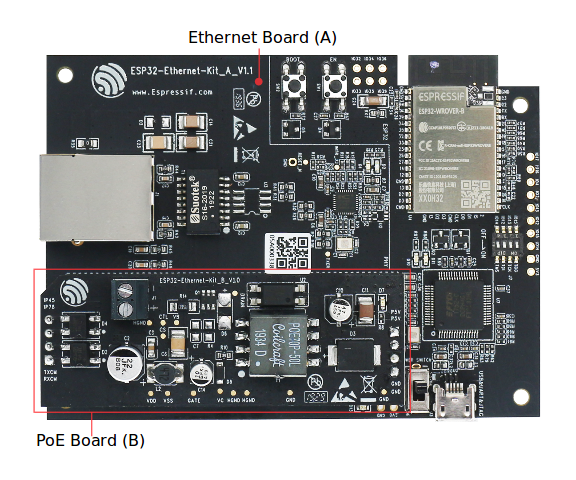
The Espressif ESP32-Ethernet-Kit is a development board that uses the ESP32-WROVER-B module. Most important features of the board are
- 100 Mbps Ethernet via IP101G PHY
- USB bridge with JTAG interface
Furthermore, some GPIOs are broken out for extension. The USB bridge based on FDI FT2232HL provides a JTAG interface for OCD debugging through the USB interface. For flashing and debugging the board, see \ref boards_esp32_esp-ethernet-kit common board documentation.
@image html "https://docs.espressif.com/projects/esp-dev-kits/en/latest/esp32/_images/esp32-ethernet-kit-v1.1.png" "ESP32-Ethernet-Kit V1.1" width=500
Hardware
This section describes
- the default board configuration,
- the board pinout.
Board Configuration
ESP32-Ethernet-Kit v1.1 has the following on-board components
- 100 Mbps Ethernet via IP101G PHY
- USB bridge with JTAG interface
For detailed information about the configuration of ESP32 boards, see section Peripherals in \ref esp32_riot.
@note Only a few GPIOs are broken out and available for external hardware on ESP32-Ethernet-Kit boards. Which GPIOs are available as peripherals depends on used modules.
Function | GPIOs | Remarks |Configuration :---------------|:-------|:--------|:---------------------------------- BTN0 | GPIO0 | not available if `esp_eth` is used | | ADC | GPIO34, GPIO35, GPIO36, GPIO39 | | \ref esp32_adc_channels "ADC Channels" DAC | - | | \ref esp32_dac_channels "DAC Channels" PWM_DEV(0) | GPIO2, GPIO4 | | \ref esp32_pwm_channels "PWM Channels" I2C_DEV(0):SDA | GPIO32 | | \ref esp32_i2c_interfaces "I2C Interfaces" I2C_DEV(0):SCL | GPIO33 | | \ref esp32_i2c_interfaces "I2C Interfaces" SPI_DEV(0):CLK | GPIO14 | HSPI is used | \ref esp32_spi_interfaces "SPI Interfaces" SPI_DEV(0):MISO | GPIO12 | HSPI is used | \ref esp32_spi_interfaces "SPI Interfaces" SPI_DEV(0):MOSI | GPIO13 | HSPI is used | \ref esp32_spi_interfaces "SPI Interfaces" SPI_DEV(0):CS0 | GPIO15 | HSPI is used | \ref esp32_spi_interfaces "SPI Interfaces" UART_DEV(0):TxD | GPIO1 | Console (configuration is fixed) | \ref esp32_uart_interfaces "UART interfaces" UART_DEV(0):RxD | GPIO3 | Console (configuration is fixed) | \ref esp32_uart_interfaces "UART interfaces" \n @note SPI_DEV(0) is not available if module `esp_jtag` is used. For the SPI_DEV(0) pins to work properly, the function switches (DIP switches) for the JTAG signals must be set to OFF.Board Pinout
The board schematic can be found here.
By default, only 4 bidirectional GPIO pins are unused: GPIO2, GPIO4, GPIO32, GPIO33. The suggested configuration is for PWM and I2C, but they can also be used for SPI or another serial port. By disabling the JTAG interface on the board, another 4 GPIOs can be made available (GPIO12, GPIO13, GPIO14, GPIO15).
Other Documentation Resources
There is a comprehensive Getting Started Guide for the ESP32-Ethernet-Kit with a lot information about hardware configuration.