
14 KiB
@defgroup boards_sipeed_longan_nano Sipeed Longan Nano @ingroup boards @brief Support for the Sipeed Longan Nano board @author Gunar Schorcht gunar@schorcht.net
\section sipeed_longan_nano Sipeed Longan Nano
Overview
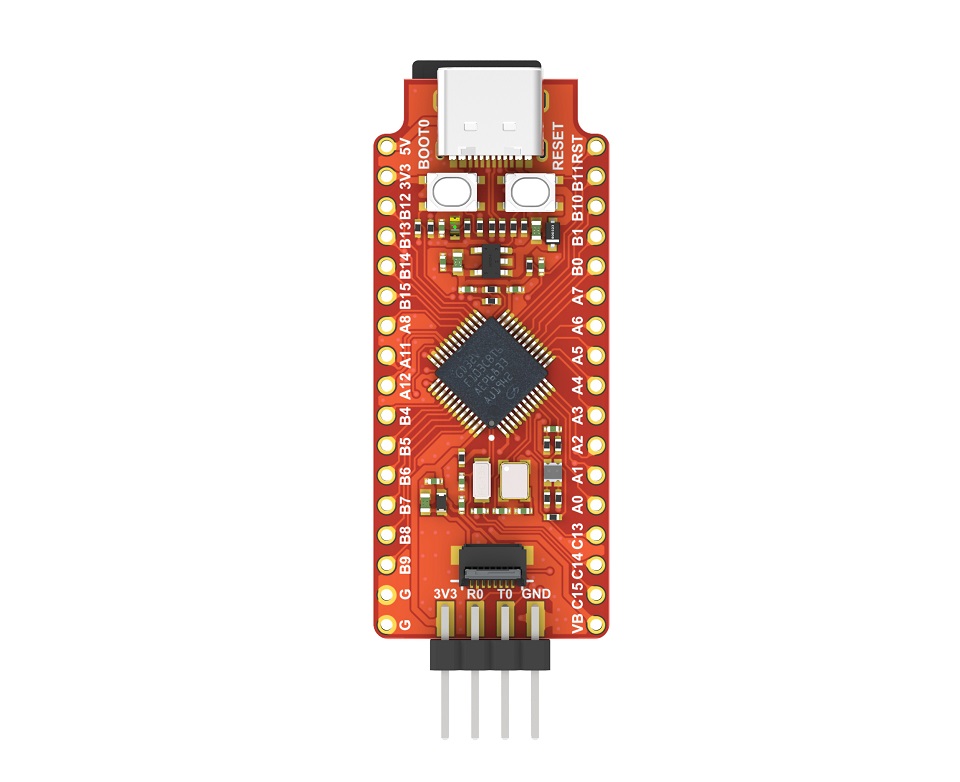
The Sipeed Longan Nano is a development board for the GigaDevice GD32VF103CBT6 MCU with the following on-board components:
- GD32VF103CBT6 RISC-V MCU @108MHz
- USB Type C
- TF card slot
- 3 user LEDs
- 0.96" TFT display 160 x 80 pixel (optional)
@image html "https://wiki.sipeed.com/hardware/assets/Longan/nano/Longan_nano.124.jpg" "Sipeed Longan Nano" width=600
Hardware
| MCU | GD32VF103CBT6 | Supported |
|---|---|---|
| Family | RISC-V with ECLIC | |
| Vendor | GigaDevice | |
| RAM | 32 kByte | |
| Flash | 128 KByte | |
| Frequency | 108 MHz | |
| Power Modes | 3 (Sleep, Deep Sleep, Standby) | yes |
| GPIOs | 37 | yes |
| Timers | 5 x 16-bit timer | yes |
| RTC | 1 x 32-bit counter, 20-bit prescaler | yes |
| WDT | 2 x 12-bit counter, 3-bit prescaler | yes |
| ADC | 2 x 12-bit units, 16 channels @ 1 Msps | yes |
| DAC | 2 x 12-bit channel | yes |
| UART | - | yes |
| USART | 3 | yes |
| SPI | 3 | yes |
| I2C | 2 x Fast Mode 400 kHz | yes |
| I2S | 2 | no |
| CAN | 2 x CAN 2.0B with up to 1 Mbps | no |
| PWM | 6 Channels | yes |
| USB | 1 x USB FS OTG | yes |
| Vcc | 3.0V - 3.6V | |
| Datasheet | Datasheet | |
| Reference Manual | Reference Manual | |
| Board Manual | Board Manual | |
| Board Schematic | Board Schematic |
Pin Layout / Configuration
The general pin layout is shown below.
@image html "https://longan.sipeed.com/assets/longan_nano_pinout_v1.1.0_w5676_h4000_large.png" "Sipeed Longan Nano Pinout" width=800
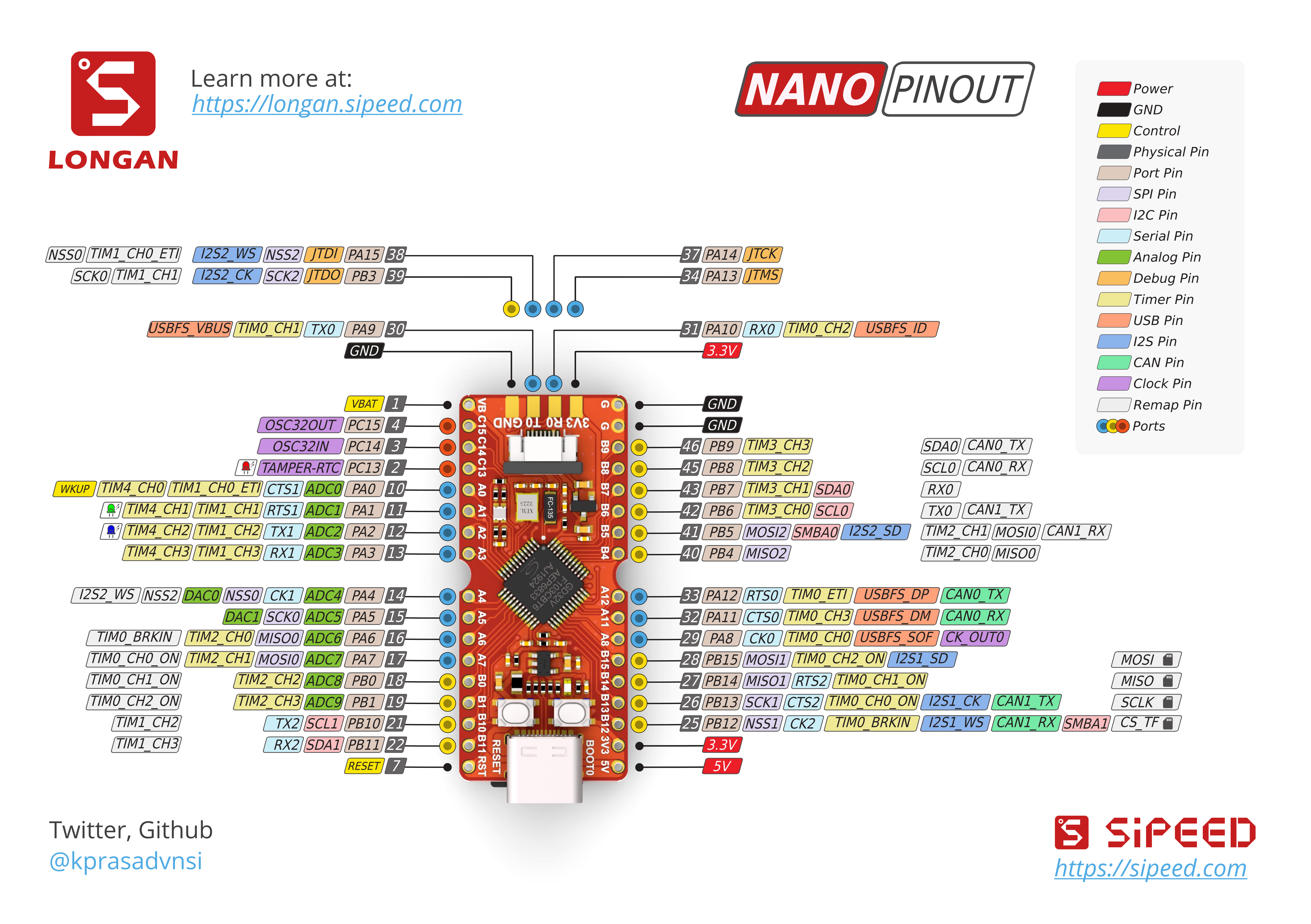
The following tables show the connection of the on-board components with the MCU pins and their configuration in RIOT sorted by RIOT peripherals and by pins.
| RIOT Peripheral | MCU Pin | MCU Peripheral | Board Function | Remark |
|---|---|---|---|---|
| ADC_LINE(0) | PA0 | ADC01_IN0 | ||
| ADC_LINE(1) | PA3 | ADC01_IN3 | ||
| ADC_LINE(2) | - | ADC01_IN16 | internal Temperature channel | |
| ADC_LINE(3) | - | ADC01_IN17 | internal VFEF channel | |
| ADC_LINE(4)* | PA4 | ADC01_IN4 | N/A if DAC is used | |
| ADC_LINE(5)* | PB0 | ADC01_IN8 | TFT RS | N/A if TFT is used |
| ADC_LINE(6)* | PB1 | ADC01_IN9 | TFT RST | N/A if TFT is used |
| ADC_LINE(7)* | PA6 | ADC01_IN6 | N/A if TFT/SPI_DEV(1) is used | |
| ADC_LINE(8)* | PA7 | ADC01_IN7 | N/A if TFT/SPI_DEV(1) is used | |
| ADC_LINE(9)* | PA5 | ADC01_IN5 | N/A if TFT/SPI_DEV(1)/DAC used | |
| BTN0 | PA8 | BOOT0 | BOOT | |
| DAC_LINE(0) | PA4 | DAC0 | ||
| DAC_LINE(1)* | PA5 | DAC1 | N/A if TFT is used | |
| GPIO_PIN(1, 2) | PB2 | TFT CS | ||
| I2C_DEV(0) SCL | PB6 | I2C0 SCL | ||
| I2C_DEV(0) SDA | PB7 | I2C0 SDA | ||
| I2C_DEV(1) SCL | PB10 | I2C1 SCL | ||
| I2C_DEV(1) SDA | PB11 | I2C1 SDA | ||
| LED0 | PC13 | LED red | ||
| LED1 | PA1 | LED green | ||
| LED2 | PA2 | LED blue | ||
| PWM_DEV(0) CH0 | PA1 | LED green | ||
| PWM_DEV(0) CH1 | PA2 | LED blue | ||
| PWM_DEV(1) CH0* | PB8 | N/A if CAN is used | ||
| PWM_DEV(1) CH1* | PB9 | N/A if CAN is used | ||
| SPI_DEV(0) CS | PB12 | SPI1 CS | SD CS | |
| SPI_DEV(0) SCLK | PB13 | SPI1 SCLK | SD SCK | |
| SPI_DEV(0) MISO | PB14 | SPI1 MISO | SD MISO | |
| SPI_DEV(0) MOSI | PB15 | SPI1 MOSI | SD MOSI | |
| SPI_DEV(1) CS | PB5 | SPI0 CS | ||
| SPI_DEV(1) SCLK | PA5 | SPI0 SCLK | TFT SCL | |
| SPI_DEV(1) MISO | PA6 | SPI0 MISO | ||
| SPI_DEV(1) MOSI | PA7 | SPI0 MOSI | TFT SDA | |
| UART_DEV(0) TX | PA9 | USART0 TX | UART TX | |
| UART_DEV(0) RX | PA10 | USART0 RX | UART RX |
(*) The availability of these peripherals depend on the use of other peripherals.
\n
@note For the Sipeed Longan Nano board version with TFT display, the
sipeed-longan-nano-tft board definition has to be used.
BOARD=sipeed-longan-nano-tft make ...
| Pin | Board Function | RIOT Function 1 | RIOT Function 2 | RIOT Function 3 |
|---|---|---|---|---|
| PA0 | ADC_LINE(0) | |||
| PA1 | LED green | PWM_DEV(0) CH0 | LED0 | |
| PA2 | LED blue | PWM_DEV(0) CH1 | LED1 | |
| PA3 | ADC_LINE(1) | |||
| PA4 | ADC_LINE(4)* | DAC_LINE(0) | ||
| PA5 | TFT SCL | SPI_DEV(1) SCLK | ADC_LINE(9)* | DAC_LINE(1)* |
| PA6 | SPI_DEV(1) MISO | ADC_LINE(7)* | ||
| PA7 | TFT SDA | SPI_DEV(1) MOSI | ADC_LINE(8)* | |
| PA8 | BOOT | BTN0 | ||
| PA9 | UART_DEV(0) TX | |||
| PA10 | UART_DEV(0) RX | |||
| PA11 | USB D- | |||
| PA12 | USB D+ | |||
| PA13 | JTAG TMS | |||
| PA14 | JTAG TCK | |||
| PA15 | JTAG TDI | |||
| PB0 | TFT RS | ADC_LINE(5)* | ||
| PB1 | TFT RST | ADC_LINE(6)* | ||
| PB2 | TFT CS | |||
| PB3 | JTAG TDO | |||
| PB4 | JTAG NRST | |||
| PB5 | SPI_DEV(1) CS | |||
| PB6 | I2C_DEV(0) SCL | |||
| PB7 | I2C_DEV(0) SDA | |||
| PB8 | PWM_DEV(1) CH0 | |||
| PB9 | PWM_DEV(1) CH1 | |||
| PB10 | I2C_DEV(1) SCL | |||
| PB11 | I2C_DEV(1) SDA | |||
| PB12 | SD CS | SPI_DEV(0) CS | ||
| PB13 | SD SCK | SPI_DEV(0) SCLK | ||
| PB14 | SD MISO | SPI_DEV(0) MISO | ||
| PB15 | SD MOSI | SPI_DEV(0) MOSI | ||
| PC13 | LED red | LED2 | ||
| PC14 | OSC32IN | |||
| PC15 | OSC32OUT | |||
| - | Temperature | ADC_LINE(2) | ||
| - | VREF | ADC_LINE(3) |
(*) The availability of these peripherals depend on the use of other peripherals.
@note Since the availability of ADC_LINE(4) to ADC_LINE(9) depends on other
peripheral configurations, their index may vary.
Flashing the Device
Using the DFU bootloader
The board is flashed via the in-ROM DFU bootloader by default. To enter bootloader mode, hold the BOOT0 button while pressing the RESET button.
BOARD=sipeed-longan-nano make -C examples/basic/hello-world flash
After flashing you need to leave bootloader mode again by pressing the RESET button.
@note For the Sipeed Longan Nano board version with TFT display, the
sipeed-longan-nano-tft board definition has to be used.
BOARD=sipeed-longan-nano-tft make -C examples/basic/hello-world flash
Using an external debug adapter
The board can also be flashed via a JTAG interface with OpenOCD (at least
release version 0.12.0).
By default, an FTDI adapter according to the configuration defined in
interface/openocd-usb.cfg
is assumed.
PROGRAMMER=openocd BOARD=sipeed-longan-nano make -C examples/basic/hello-world flash
To use an FTDI adapter with a different configuration, the configuration can be
defined using the variable OPENOCD_FTDI_ADAPTER, for example:
PROGRAMMER=openocd OPENOCD_FTDI_ADAPTER=tigard BOARD=sipeed-longan-nano make -C examples/basic/hello-world flash
If another adapter is used, it can be specified using variable
OPENOCD_DEBUG_ADAPTER, for example for a Segger J-Link adapter:
PROGRAMMER=openocd OPENOCD_DEBUG_ADAPTER=jlink BOARD=sipeed-longan-nano make -C examples/basic/hello-world flash
Using the TFT Display
To use the display of the Sipeed Longan Nano board version with TFT display,
the sipeed_longan_nano_tft board definition has to be used, for example:
BOARD=sipeed-longan-nano-tft make -C tests/drivers/st7735 flash
Accessing STDIO
By default, the stdio is provided by the USBUS CDC ACM module stdio_cdc_acm.
This interface is mapped to /dev/ttyACM<n> on a Linux host, where <n> is
the index of the CDC ACM interface, which is 0 by default.
To use the first UART interface for stdio instead, the stdio_uart module
has to be enabled:
USEMODULE=stdio_uart BOARD=sipeed-longan-nano make -C examples/basic/hello-world flash
The stdio is then directly accessible through the first UART interface. If an
external USB-to-UART interface is used, this interface is mapped to
/dev/ttyUSB<n> on a Linux host, where <n> is the index of the UART
interface, which is 0 by default.
Use the term target to connect to the board using /dev/ttyUSB0:
BOARD=sipeed-longan-nano make -C examples/basic/hello-world term PORT=/dev/ttyUSB0
If the UART interface index of the USB-to-UART interface is not 0, use the following command to connect:
BOARD=sipeed-longan-nano make -C examples/basic/hello-world term PORT=/dev/ttyUSB<n>