mirror of
https://github.com/RIOT-OS/RIOT.git
synced 2025-12-19 19:43:52 +01:00

105 lines
5.1 KiB
Markdown
105 lines
5.1 KiB
Markdown
@defgroup boards_common_native Common Native Board
|
|
@ingroup boards_common
|
|
@brief Shared files and configuration for native.
|
|
|
|
# Overview
|
|
|
|
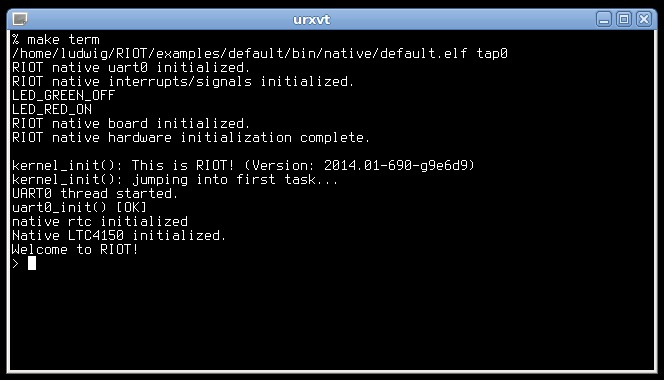
The RIOT native boards use system calls and signals to emulate hardware at the API level.
|
|
That means that you can compile the complete RIOT software stack for your *NIX system
|
|
and run it as a process. Reasons why you might want to do that are:
|
|
- You want to try out RIOT but don't have one of the supported hardware platforms
|
|
- You are developing an application for RIOT or you are hacking on RIOT itself and
|
|
want to test and debug without the limitations and requirements of debugging on actual hardware
|
|
- You want to experiment with network protocols in a [controlled environment](https://github.com/RIOT-OS/RIOT/wiki/Virtual-riot-network)
|
|
|
|
Two different boards are currently available, depending on the host platform: @ref boards_native32
|
|
and @ref boards_native64. Using `BOARD=native` will automatically select the right variant.
|
|
|
|
|
|
|
|
# Hardware
|
|
- CPU: Host CPU
|
|
- RAM: Host RAM
|
|
- Flash:
|
|
- for program execution: Host file system
|
|
- for the @ref drivers_periph_flashpage : emulated in RAM
|
|
- Network: Tap Interface
|
|
- UART: Runtime configurable - `/dev/tty*` are supported
|
|
- Timers: Host timer
|
|
- RTC: host time at `UTC` for consistent behavior with embedded systems.
|
|
The environment variable `TZ` can be used to explicitly set a specific or hosts timezone (see [below](#setting-a-timezone)).
|
|
- LEDs: One red and one green LED - state changes are printed to the UART
|
|
- PWM: Dummy PWM
|
|
- QDEC: Emulated according to PWM
|
|
- SPI: Runtime configurable - `/dev/spidev*` are supported (Linux host only)
|
|
- GPIO: Runtime configurable - `/dev/gpiochip*` are supported (Linux host only)
|
|
|
|
# Configuration
|
|
|
|
Some aspects of a native RIOT instance can be configured at runtime.
|
|
To get an overview invoke the program with the `-h` option. Example:
|
|
```shell
|
|
$ examples/basic/default/bin/native64/default.elf -h
|
|
usage: examples/basic/default/bin/native64/default.elf <tap interface 1> [-i <id>] [-d] [-e|-E] [-o] [-c <tty>] [-g <gpiochip>] [-i <id>] [-d] [-e|-E] [-o] [-c <tty>] [--eui64 <eui64> …]
|
|
|
|
help: examples/basic/default/bin/native64/default.elf -h
|
|
|
|
Options:
|
|
-h, --help
|
|
print this help message
|
|
-i <id>, --id=<id>
|
|
specify instance id (set by config module)
|
|
-s <seed>, --seed=<seed>
|
|
specify srandom(3) seed (/dev/random is used instead of random(3) if
|
|
the option is omitted)
|
|
-d, --daemonize
|
|
daemonize native instance
|
|
-e, --stderr-pipe
|
|
redirect stderr to file
|
|
-E, --stderr-noredirect
|
|
do not redirect stderr (i.e. leave sterr unchanged despite
|
|
daemon/socket io)
|
|
-o, --stdout-pipe
|
|
redirect stdout to file (/tmp/riot.stdout.PID) when not attached
|
|
to socket
|
|
-c <tty>, --uart-tty=<tty>
|
|
specify TTY device for UART. This argument can be used multiple
|
|
times (up to UART_NUMOF)
|
|
-g <gpio>, --gpio=<gpio>
|
|
specify gpiochip device for GPIO access.
|
|
This argument can be used multiple times.
|
|
Example: --gpio=/dev/gpiochip0 uses gpiochip0 for port 0
|
|
-U <eui64>, --eui64=<eui64>
|
|
provide a ZEP interface with EUI-64 (MAC address)
|
|
This argument can be provided multiple times
|
|
-w <tap>
|
|
Add a tap interface as a wireless interface
|
|
```
|
|
|
|
As with any platform, you can specify the sizes of your stacks, i.e. the amount of space your application can use.
|
|
You may wish to use a more realistic stack size than native's `THREAD_STACKSIZE_DEFAULT` to increase realism.
|
|
|
|
# Setting a timezone {#setting-a-timezone}
|
|
|
|
RIOT native defaults to `UTC` timezone if `TZ` is not set in the environment,
|
|
to keep behavior of `time.h` functions like `mktime` consistent with embedded setups,
|
|
which usually do not use timezones.
|
|
If your application requires the same timezone as host, the `TZ` environment variable should be set accordingly.
|
|
There are several ways to achieve that:
|
|
- execute `export TZ=":/etc/localtime"` prior `make term`
|
|
in the very shell you intend to run `make term` in
|
|
- add `export TZ=":/etc/localtime"` to your `~/.profile`
|
|
- run `TZ=":/etc/localtime" make term`
|
|
|
|
The timezone can also be set at runtime by the application for both native and embedded devices using `setenv("TZ", <timezonestring>, 1)`. `picolibc` and `newlibc` expect `<timezonestring>` to have the form `NAME+/-hh:mm:ss<DST-handling>` (`+` pointing west -> `CET-1` adds 1 hour to UTC, see `man timezone`)
|
|
e.g., `ACST-9:30ACDT-10:30,M10.1.0,M4.1.0`.
|
|
If the `TZ`-string can not be interpreted by the used `libc` (`newlib`,`picolibc`,`glibc`),
|
|
they default back to `UTC`.
|
|
|
|
@warning Some things will behave faulty, since the assumption of most pkgs and
|
|
system modules is to run on a embedded system with no timezone set.
|
|
One often used function that respect timezone setting is `mktime`
|
|
|
|
# Known Issues
|
|
Check the list of open issues labeled native in the [github issue tracker](https://github.com/RIOT-OS/RIOT/issues?q=is%3Aissue%20state%3Aopen%20label%3A%22Platform%3A%20native%22)
|